
Soda Fountain Margin: How Much a Free Refill Actually Costs You
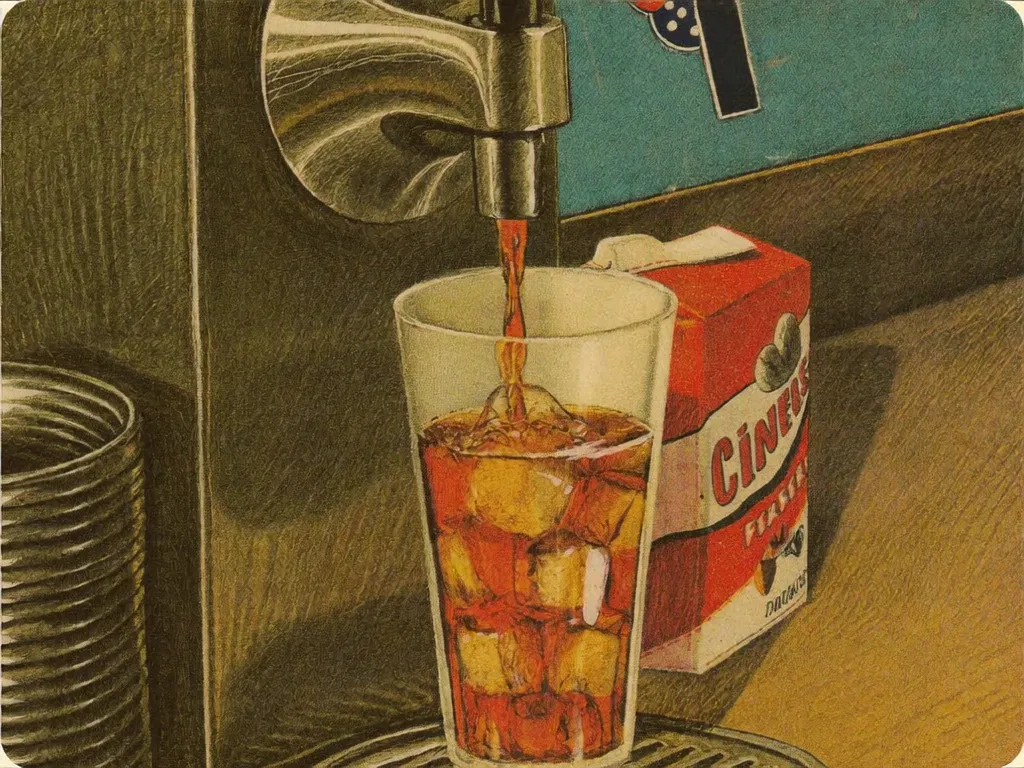

The first time somebody asked me what the cost of a fountain drink was, I said about a dollar.
I was off by a factor of five.
The actual cost was closer to twenty cents. The customer was paying $3.50. Two years into working restaurants and I had no clue fountain was the highest-margin item on the menu, and it wasn’t close. No manager told me. None of my training said it. The number lives in the BIB price sheet that nobody in the front of house ever looks at.
This post is the math somebody should have walked me through on day one. If you’ve already done the BIB math at your bar and you’re reading this for sport, skip down to the failure-modes section. That’s where the actually useful stuff lives.
The short answer #
A fountain drink costs about $0.35 to $0.49 once you count the cup, lid, straw and CO2, depending on store-brand or branded syrup. On a $3.50 drink that is a 10 to 14% pour cost. Free refills average 1.4 drinks a visit and push branded cola to about 17.6%, which still beats most of the food on your menu. The real leaks are cup costs and prices nobody has touched since 2017, not the refills.
What is in a fountain drink, cost-wise #
Five things. None of them are expensive on their own:
- Syrup. Comes in a bag-in-box (BIB) the operator buys from the distributor.
- Carbonated water. Made on-site from CO2 and tap.
- Ice. Water bill plus ice machine amortization.
- Cup, lid, straw. The disposables stack.
- CO2. Replenished from the tank in the back.
That’s the entire cost of goods on a fountain pour. What the customer pays for is the experience, the ice, the disposable cup, and the brand on the label. The actual liquid in the cup costs less than the napkin under it.
The BIB math #
A standard branded BIB is five gallons. That is 640 ounces of concentrated syrup (WebstaurantStore).
The mix ratio for fountain is 5:1, five parts carbonated water to one part syrup. Diet runs 4:1. Specialty syrups can go 6:1.
640 ounces of syrup at a 5:1 mix yields 3,840 ounces of finished beverage (640 syrup + 3,200 water). That is about 342 sixteen-ounce pours after a 30% ice fill, or 240 if you pour straight to the rim with no ice.
A branded cola BIB runs $80-95 (BinWise). Proprietary or store-brand syrups for the same volume run $35-50. Call a branded BIB $90 for round numbers.
$90 ÷ 342 servings = $0.26 per drink, syrup cost.
Add the rest of the stack:
- 16 oz cup + lid + straw: ~$0.18 (industry mid-range disposable cost)
- CO2 + carbonated water + ice + minor amortization: ~$0.05
Total: roughly $0.49 per fountain drink. Sold at $3.50, that is a 14% pour cost before refills, leaving $3.01 of contribution margin per drink.
If you skip the branded BIB and run a proprietary or store-brand syrup at $40 a box: $0.12 syrup cost. Add the same disposable + CO2 stack and you are at $0.35 per drink, a 10% pour cost, $3.15 contribution margin.
That’s why concepts that own their drink mix print money on beverages. Think regional chains, the burger spots with their own root beer, the quick-service that runs Polar or Faygo or some weird local. The brand cola is paying for marketing. The math is paying for everything else.
Where the ice math hides margin #
Ice is the input most operators forget to recheck when they bump cup size.
A 16 oz cup with 30% ice fill holds 11.2 oz of liquid, not 16. The cup is sized so the customer thinks they’re getting more drink than they are. That’s not a scam. That’s the entire fountain category. Ice is part of the experience and part of the math, and cold soda is the point anyway.
But the math gets weird when you offer free refills. The customer comes back for a refill on a cup that holds 11.2 ounces of soda, not 16. So the cost of the refill is 11.2 ounces of finished drink, not 16. Ice fill is doing two jobs at once: lowering your cost per pour AND lowering your cost per refill.
Then you bump from 16 oz cups to 20 oz “large” cups for an extra fifty cents. Now the customer holds 14 oz of soda after ice. You doubled your menu options, raised your price, your absolute cost went up a few cents per pour, and you almost certainly forgot to recalculate the refill exposure on the bigger cup. I’ve watched plenty of operators do exactly that.
Recalculate when you change cup size. Always.
What free refills actually cost #
Free refills add a multiplier on every drink sold.
Industry rule of thumb: 1.4 pours per visit when refills are free (BinWise). The syrup, CO2 and ice get refilled, the cup doesn’t, so that’s 40% more on the liquid side of every drink. Your $0.49 cost per drink becomes about $0.62 per visit. Your $3.50 menu price still stands. Pour cost on a refill program goes from 14% to 17.6%.
Two things to notice. First, that’s still a very good pour cost. A 17.6% pour cost on a beverage at full retail is healthier than most of the food on your menu. Free fountain refills are not the leak you think they are. The real leak is probably the bar program or the comp creep on apps.
Second, you can drop the multiplier without killing the experience. A one-refill cap drops the average from 1.4 to about 1.1. Most customers don’t refill more than once. The guy who refills four times was never going to buy a second drink at full price. He’s just trying to win at fountain.
If your concept is competitive in a category where free refills are an expectation, family casual, sports bar, anything with a kids menu, keep them. Don’t even think about it. Just price the menu like the math actually is and quit hiding the cost in the food margin.
Healthy fountain pour cost benchmarks #
Plot your number against the band:
- 8-15%: healthy before free refills (store-brand syrup near the bottom, branded cola near the top)
- Rises with cup size: a 32 oz holds almost three times the syrup of a 12 oz but rarely sells for three times the price, so expect about 12-18% on a 32 oz
- Above 22%: something is broken. Cup cost too high, mix ratio is wrong on the dispenser, or you are running a 24 oz mega at $1.99 and trying to win on volume
The mix ratio is the silent killer. A dispenser tuned to 4:1 instead of 5:1 burns 20% more syrup per pour. On a high-volume concept, across a year, that’s real money walking out the door. Calibrate quarterly. The distributor will do it free if you ask. They won’t show up if you don’t, so ask.
Failure modes (what makes fountain bleed) #
Same investigation order I use for draft. Theft is rarely the answer.
1. Mix ratio drift. A dispenser that’s supposed to be 5:1 ends up running 4:1 because nobody recalibrated after a syrup line replacement. You’re giving away 20% more syrup per pour and your fountain BIBs run out faster than the math says they should. Distributor fixes it free.
2. Cup size creep. The cup vendor sent a slightly bigger 16 oz cup than the previous order. It still says 16 oz. It actually holds 18. You won’t notice. The variance report will, eventually.
3. Free refill drift on app pickups and to-go. This one’s sneaky. Some operators offer free refills on dine-in and forget that to-go orders are the same drink at the same price without the refill exposure. Margin on to-go fountain is quietly better than dine-in fountain. Most operators never price for it. They should.
4. CO2 leaks. A slow CO2 leak in the back drops the carbonation, drifts the mix ratio, and pours come out flat. Customers complain. The bartender bumps the syrup ratio to fix the taste. Now you’re paying for a leaky tank AND giving away extra syrup. The tank pressure check is a 30-second weekly task, so do it weekly.
5. The freestyle machine problem. Coca-Cola Freestyle dispensers are great for customer choice. They’re also more expensive per pour than a six-button standard fountain. If you have a Freestyle, your math is different and your price probably needs to be too. Most operators never touch the price. They should.
6. The actual theft case. It happens. New employees pour drinks for their friends. It’s the smallest fountain leak by far, and I’d check it last. If you suspect it, watch the syrup-bag exhaustion rate, not the variance report.
What to do this week #
If you’ve never costed your fountain pour, do it now. Ten minutes, tops. The result will surprise you in one of two directions. Either you’re leaving money on the table by under-pricing fountain, which is the usual case, or you’re leaning on a category whose margin is about to compress. That second one is rare, but it happens if your CO2 contract just changed.
If you want a tool that does the math for you without an email gate, we built one. Plug in your BIB cost, mix ratio, cup size, ice fill, and refill assumptions. It will show you cost per drink, profit per drink, and pour cost percentage. No upsell. Math runs in the browser.
For the wider beverage program (mixed drinks, beer, wine), the liquor pour cost calculator covers everything that is not soda.
The math on fountain is the easy part. The discipline is the hard part. You recalibrate the dispenser when somebody swaps a syrup line. You recost when the cup vendor ships a slightly different SKU. And when the demographic in the dining room shifts, you go back and check the refill assumption again. The number doesn’t lie. It’s also kinder to fountain than to almost any other line item on the menu, which is exactly why nobody’s calling it the leak it occasionally becomes.
Read next
What's a Good Prime Cost for a Bar vs a Restaurant?
A healthy prime cost by concept, how to calculate it weekly with fully loaded labor, and which half to fix when it runs hot. From a 5-year GM.
How to Price a Cocktail (The Pour Cost Math Bars Skip)
How to price a cocktail off its real pour cost, the multiplier that works, and a worked build from spirit to menu price. From a 5-year bar GM.